Share this page

Global events, Virtual events

6th IDF Nutrition and Health Symposium 2026

DATE: May 21, 2026 Google Calendar Apple Calendar Outlook
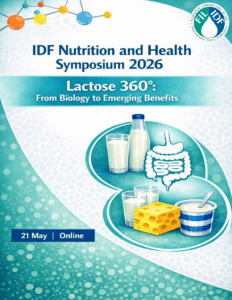
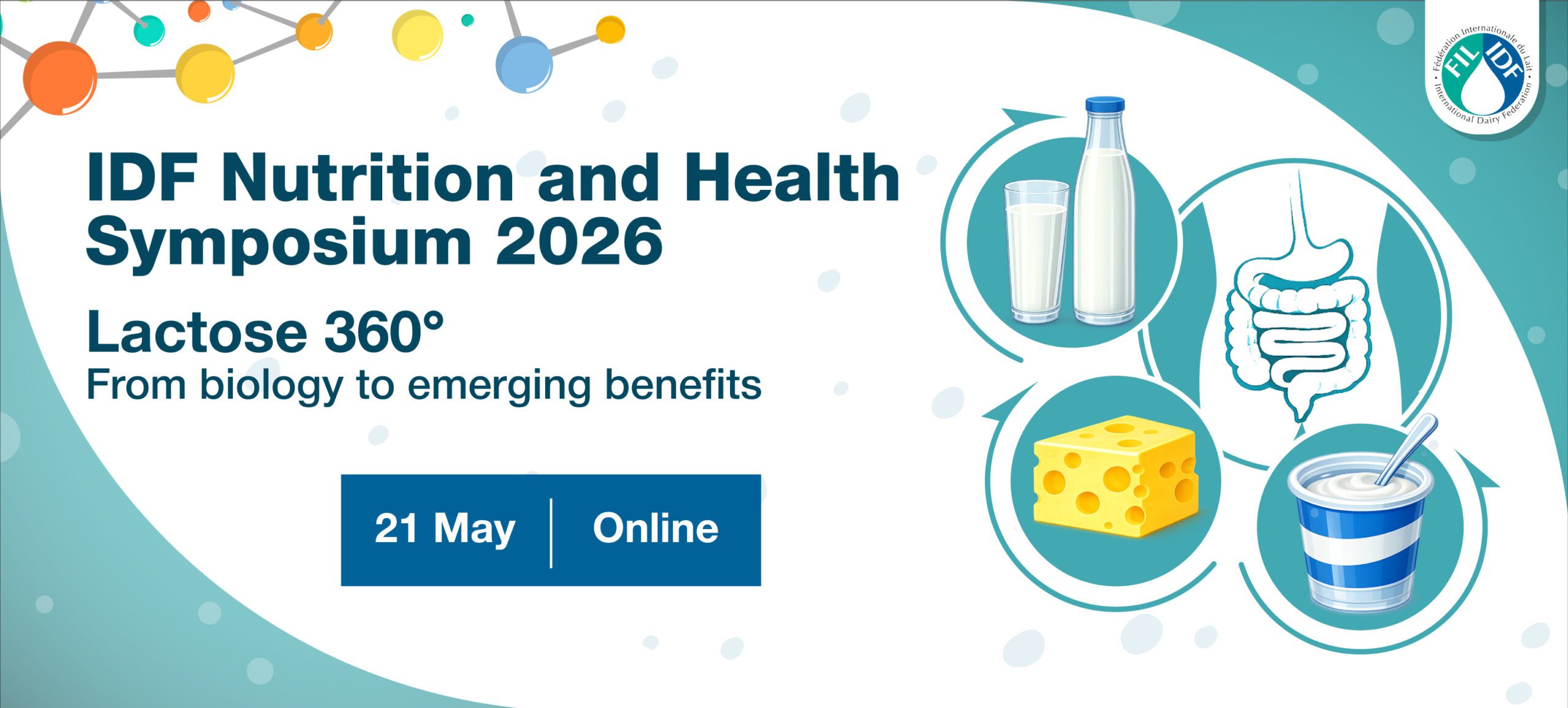
Banner for the IDF Nutrition and Health Symposium 2026 titled ‘Lactose 360°: From biology to emerging benefits’. Visuals include illustrations of milk and yogurt, a digestive system graphic, and a piece of cheese. The event date ‘21 May’ and the word ‘Online’ appear in blue boxes. IDF logo displayed in the top right corner.


IDF Nutrition and Health Symposium 2026

Lactose 360° – From biology to emerging benefits

Designed for nutrition and health professionals, this 6th IDF Nutrition and Health Symposium will be held online on 21 May and is free to attend.

🕒 Two sessions featuring the same pre-recorded presentations and live panel discussions
Session 1

07:00 – 09:00 CEST

Live Japanese interpretation

Session 2

16:00 – 18:00 CEST

 Why attend? A 360° look at lactose

Lactose continues to generate confusion among both consumers and health professionals. Although it is a naturally occurring sugar and a key component of dairy foods worldwide, persistent misconceptions about lactose digestion, intolerance, and its distinction from cow’s milk allergy often lead to unnecessary dietary restrictions, despite the important nutrients dairy provides.

The 6th IDF Nutrition and Health Symposium seeks to clarify these issues by presenting a full 360°, science-driven exploration of lactose from a health perspective, spanning physiology, clinical practice, emerging research, and practical dietary guidance. By sharing evidence-based insights from international experts, the symposium supports informed nutritional and health decisions and highlights the vital role of dairy in balanced, culturally diverse diets.

The event will:

  • Explain the physiological and genetic factors influencing lactose digestion and tolerance across the lifespan.
  • Differentiate lactose intolerance from other conditions such as milk allergy or IBS and identify evidence-based dietary management strategies.
  • Describe the nutritional and health benefits of lactose, including its role in bone, dental, and metabolic health.
  • Summarize the impact of lactose on gut microbiota and short-chain fatty acid production and understand its implications for metabolic health and type 2 diabetes.
  • Integrate mechanistic, clinical, and nutritional perspectives to inform patient guidance, dietary recommendations, and functional food development.

We look forward to welcoming you to this important and timely event.

Programme


Session 1
07:00 – 09:00 CEST
Session 2
16:00 18:00 CEST
5 min

Welcome

Ms Laurence Rycken, Director General IDF

10 min

Opening Remarks

Dr Luz María De Regil, Director, Department of Nutrition and Food Safety, World Health Organization (WHO)


5 min

Session Moderator:

Associate Professor Jessica Biesiekierski,

Head of Human Nutrition at The University of Melbourne, Australia

Session Moderator:

Professor Seema Puri,

Professor at Department of Nutrition, Institute of Home Economics, University of Delhi, India


20 min


Lactose in Nutrition: Bone Health, Energy, and Beyond

Professor Corinna Walsh, Professor at University of the Free State, South Africa

Abstract:
Lactose, the principal carbohydrate in milk and dairy foods, plays several roles in human nutrition that extends beyond its recognition as a source of dietary energy. Across the lifespan – from infancy through older adulthood – lactose contributes to metabolic, physiological, and dietary functions that support health and wellbeing. This presentation examines the nutritional significance of lactose within the broader context of the dairy food matrix and its implications for human health.

Lactose facilitates the absorption of key minerals, particularly calcium and magnesium, thereby supporting skeletal development and maintenance of bone health. In addition, digestion of lactose yields glucose and galactose, which serve as important metabolic substrates for energy production and for tissues with high metabolic demand, including the nervous and immune systems. Emerging evidence also suggests that lactose-containing foods may contribute to satiety regulation and appetite control, potentially supporting healthy body weight management.

Beyond these physiological roles, lactose consumption has been linked to broader health outcomes. Evidence indicates potential associations with reduced risk of obesity and favourable effects on dental health, particularly when consumed within nutrient-dense dairy foods. Importantly, lactose should be considered within the context of the dairy food matrix – the complex interaction of nutrients, bioactive compounds and physical food structure – which influences nutrient bioavailability and health outcomes beyond the effects of single nutrients.

The presentation will integrate mechanistic insights with practical dietary perspectives, highlighting how lactose-containing dairy foods contribute to balanced, nutrient-dense diets. Together, these insights emphasise that lactose is a functional component of dairy foods with diverse contributions to human nutrition and health.

20 min

Health Effects of Lactose: Antinutritive, Health Beneficial, or Both?

Professor Michael Gänzle, Professor at University of Alberta, Canada

Abstract:

Lactose is a main source of dietary energy for all human infants but it is conditionally digested by human adults. Lactase-phlorizin hydrolase not expressed in a majority of human adults (lactase non-persistence, LNP) but maintained in humans with ancestry in Northern Europe and the arid regions of North Africa and the Middle East (lactase persistence, LP). In human infants and in LP adults, lactose is a non-cariogenic, low-glycemic sugar. In LNP individuals, lactose is a non-digestible sugar with dose-dependent health effects. Bacterial fermentation of lactose in intestine results in production of health beneficial short chain fatty acids. Moreover, lactose fermentation increases the relative abundance of Bifidobacterium spp.. In infants, the fermentation of residual lactose in the large intestine, together with fermentation of human milk oligosaccharides, shapes the composition of intestinal microbiota towards a protective dominance of bifidobacteria. A bifidogenic effect of lactose is also consistently observed in LNP adults. Above a threshold dose of about 0.3 g / kg body weight, corresponding to about 15 g per day or 375 mL of bovine milk, intestinal lactose fermentation results in excessive gas formation (bloating) and osmotic diarrhea, i.e. adverse symptoms known as “lactose intolerance”. LNP and lactose intolerance do not completely overlap. The dose-dependent beneficial or adverse health effects of lactose are shared with other non-digestible oligosaccharides, including those marketed as “prebiotics”. Consumption of fermented dairy products alleviates lactose intolerance either by removal of lactose, e.g. in cheese, or by release of bacterial β-galactosidase during intestinal transit, which functionally replaces the brush border lactase-phlorizin hydrolase. In conclusion, lactose has both adverse and health beneficial nutritional properties but a personalized nutrition approach that considers the genotype of individuals allows consumption of dairy products to enjoy the benefits without suffering adverse effects.

20 min

Should the Role of Lactose be Reconsidered in Adults with Loss of Ability to Digest it

Assistant Professor Andrew Szilagyi, Assistant Professor and Gastroenterologist at Sir Mortimer Jewish General Hospital, Canada

Abstract:
Lactose is a disaccharide of galactose and glucose which represents an essential nutrient in all neonate mammals. Glucose is utilized for nutrition and galactose has pleiotropic developmental functions. Virtually all neonates can digest lactose via brush border lactase phlorizin hydrolase. Breast feeding via milk oligosaccharides leads to a bifidobacterial microbiome which is associated with multiple health benefits. Through, genetic programing all mammals and about 3/4-1/3 of human adult populations lose 90% of this enzyme. This dichotomy of the human population is determined by multiple single nucleotide polypeptides of which 5 major genes are responsible for global distributions. Some of these lactase-reduced persons can suffer gastrointestinal symptoms which is shared with many other conditions when lactose is consumed in large enough irregular doses. Further, other nutrients in milk can cause symptoms resembling lactose intolerance. As well symptoms can be modified by a number of variables and diseases. However, regular consumption of lactose containing foods by maldigesters spill 90% into the colon (as opposed to digesters of 8%) and within a short time expand the bacterial population of bifidobacteria and some lactobacilli. These changes are likely associated with benefits to the host. Such bifidogenic expansion to date has not been seen in lactose digesters. For example, multiple studies have been carried out to determine effects of dairy products on various diseases. In general, these found reduction of risks for several diseases. Among these, one of the most studied has been colorectal cancer. This model displayed 2 potentially important characteristics. First, genetic predictions of effects are inappropriate and second, the recognition that there exist 2 populations which when analyzed together, are at risk for statistical bias (with a reduction of benefit) compared to separate population analysis. These latter conclusions will need further validation but may then apply to analyses of other diseases as well.

20 min

Dietary Management of Lactose Intolerance

Professor Miranda Lomer, Professor of Dietetics in Gastroenterology at King’s College London, United Kingdom

Abstract:
Lactose is a unique and fascinating carbohydrate only found in mammalian milk. Lactose malabsorption is common and present in people with lactase non-persistence and lactase persistence. Lactose intolerance is widespread throughout the world and subjects usually avoid milk and dairy products to improve symptoms. Not everyone with lactose malabsorption has lactose intolerance, as several nutritional and genetic factors influence tolerance. Lactose digestion mechanisms, focusing on lactase enzyme function in the small intestine will be discussed along with lactose intolerance, covering prevalence, symptoms and diagnostic methods. Best practices for the diagnosis of lactose intolerance and its overlap with irritable bowel syndrome will be discussed. Evidence based dietary management strategies, such as low FODMAP diet and induction of tolerance through continued, gradually increased lactose consumption and address misconceptions about dairy exclusion and nutritional adequacy for lactose-intolerant adults. The use of lactose free and reduced lactose dairy products, symptom management approaches will be discussed. Practical strategies for incorporating dairy into lactose restricted diets, while ensuring nutritional adequacy and overall diet quality will also be presented. Most people will tolerate some lactose in their diet even with lactose intolerance. Mixed meals, gastric emptying and transit time all have an effect on lactose tolerance. Lactose can also act as a prebiotic and gradual reintroduction helps tolerance and colonic adaptation.


15 min

Panel Discussion

Professor Corinna Walsh

Professor Miranda Lomer

Dr Jan Geurts, Principal Scientist at Royal FrieslandCampina, The Netherlands

Panel Discussion

Professor Corinna Walsh

Professor Michael Gänzle

Assistant Professor Andrew Szilagyi


5 min

Closing Remarks

Associate Professor Jessica Biesiekierski

Closing Remarks

Professor Seema Puri

  Close Close

Related reports & publications

IDF provides a permanent source of authoritative scientific and other information on a whole range of topics relevant to the dairy sector.